The Best Accent Chair Types for Small Spaces
Before styling comes selection. The chair silhouette determines how much visual weight it carries in the room, and visual weight matters as much as physical footprint in a small space.
Slipper chair: the best default for tight spaces. No arms means a smaller floor footprint, and the clean profile reads as light in the room. Best for corners and beside sofas where clearance is limited.
Barrel chair: the curved wraparound back solves a specific Montreal apartment problem — the floating chair that looks disconnected from the room. The barrel form fills an awkward corner naturally and reads as intentional rather than incidental. Works especially well in open-plan Rosemont and Plateau layouts where the seating zone needs definition.
Armless accent chair: the quietest option in terms of visual weight. Ideal alongside a sofa where a full armchair would compete for space. Easy to reposition without reorganizing the room.
Swivel chair: adds a function that small open-plan spaces genuinely need — one chair that can face the television, then rotate toward the dining area or a guest on the sofa. In a studio or open-concept condo, this flexibility is worth more than a fixed chair that serves only one orientation.
What to avoid in rooms under 10 feet wide: club chairs, chair-and-a-half configurations, and oversized wingbacks. These carry too much visual weight for a compact salon and leave insufficient clearance around them to feel comfortable.
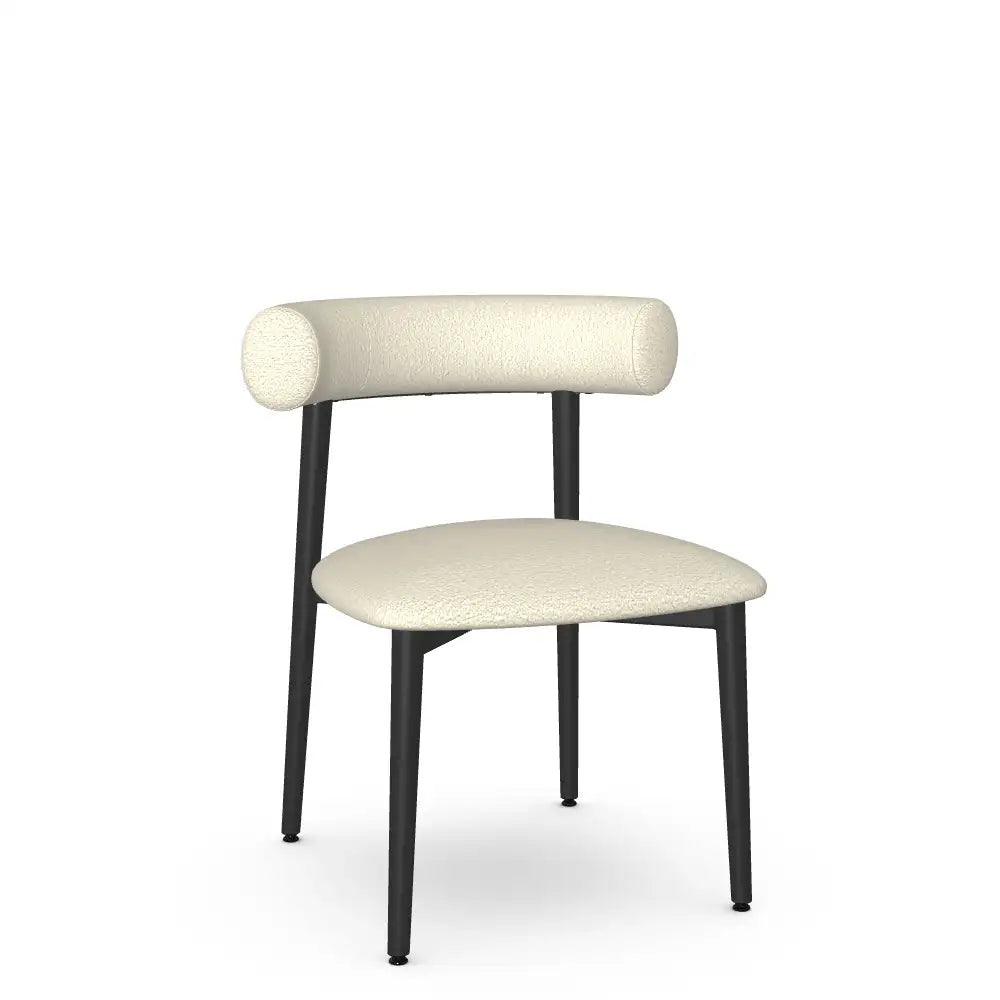
Two rules to carry into every selection. First, the chair's seat width should not exceed one-third of the sofa's total length. A chair that approaches sofa scale in a small room stops reading as an accent and starts reading as a second sofa. Second, choose a chair with visible legs — tapered wood, slim metal, any elevated base — rather than a skirted or platform design. A chair whose legs are visible allows the eye to travel beneath it, making the floor feel larger and the room feel more open.
How to Measure Before You Buy
Minimum clearance from the sofa to the accent chair: 18 inches. Minimum clearance for the main walkway around the seating zone: 30 inches. Before ordering, tape the chair's footprint on the floor using painter's tape and live with it for a day. If it blocks a natural path or makes the room feel compressed, the placement or the size needs to change. The visual weight test is simple: if you can see a meaningful section of floor beneath the chair from a standing position, the room breathes. If the chair sits flush to the floor with no visible base, it reads heavier than it needs to.
Placement Strategies That Work in Montreal Apartments
Generic placement guides are written for homes with dedicated living rooms, entry halls, and enough square footage to experiment freely. Montreal apartments require more specific thinking. Three configurations work consistently in the salon layouts most common to this city.
Configuration 1 — The Conversation Triangle. The sofa, accent chair, and coffee table form a triangle, with all three pieces relating to each other at a conversational scale. The chair should be angled 15 to 30 degrees toward the sofa rather than placed perpendicular to the wall. A chair pushed flat against a wall and pointed straight into the room does not participate in the seating arrangement — it observes it. The angle is what makes it part of the conversation.
Configuration 2 — The Corner Reader. An accent chair placed in a corner, paired with a floor lamp positioned behind and slightly to its side, and a small side table within reach, becomes a defined destination in the room. This is one of the most effective uses of a small salon accent chair, as it turns a dead corner into a functional zone. In pre-war Plateau and Mile-End apartments with high ceilings, a chair with a taller back works well in this position — the vertical scale reads correctly within the room's proportional context.
Configuration 3 — The Open-Plan Divider. In a studio or open-concept condo where living and dining share a single continuous space — common in Rosemont, NDG, and newer Verdun developments — the accent chair's back can suggest a boundary between zones without a physical wall. Positioning the chair so its back faces the dining area and its seat faces the sofa creates a soft territorial edge that organizes the floor plan without dividing it.
One rule applies across all three configurations: the accent chair's front legs should sit on the same area rug as the sofa. A chair that floats on a bare floor, while the sofa anchors a rug, looks disconnected and makes the seating zone feel unresolved. The rug unifies the arrangement.
What does not work, in any configuration, is pushing the accent chair against the wall and leaving it there. A chair with its back to the wall and nothing around it is furniture waiting to be used. An angled chair pulled into the room with clearance on both sides is in a room that has been arranged.
Small Space, Big Style — The Accent Chair Rules That Always Work
These principles apply regardless of apartment size, sofa style, or design direction. Keep them as a reference before and after the purchase.
- Choose a chair whose seat width is no more than one-third of your sofa's total length — anything wider stops reading as an accent.
- Select a chair with visible legs rather than a skirted or platform base — exposed legs allow the floor to read continuously underneath, which makes the room feel larger.
- Angle the chair 15 to 30 degrees toward the sofa — a chair pointed at a wall does not participate in the room.
- Keep the chair's front legs on the same area rug as the sofa — this unifies the seating zone and prevents the chair from floating.
- Limit accessories to three per chair—throw, pillow, and one light source or side table.
- Match the chair to one existing element in the room, not the sofa directly — one shared reference point creates coherence without matching.
- Maintain 18 inches of clearance between the sofa and the chair, and 30 inches on the main walkway — comfort depends on circulation as much as proportion.