Skip to content
en

Tall Dresser vs Wide Dresser How to Choose the Right Bedroom Storage

MAY , 2026

Beige channel-tufted upholstered bed with tufted footboard and matching brass nightstand and six-drawer dresser in minimalist bedroom with ocean view
Ivory curved upholstered bed with arched panel headboard and three round nail head ottomans beside mirrored nightstands in all-white luxury bedroom

What Is a Tall Dresser

A tall dresser, also called a chest of drawers or highboy, is a storage piece built to maximize vertical space rather than horizontal wall coverage. The typical height range is 50 to 65 inches, with a width of 30 to 40 inches and a depth of 18 to 22 inches. The defining design principle is the vertical stack: drawers are arranged in a single column, keeping the floor footprint narrow while delivering five to seven drawers of storage within a compact wall envelope.

Dark walnut platform bed with tall vertical channel-tufted upholstered headboard panel and two-tone white and wood nightstands in bright coastal bedroom

The Highboy Dresser as Architectural Statement

Highboy dressers represent the most architecturally formal variant within the tall dresser category, featuring a two-section stacked construction elevated on legs. This creates a visual presence suited to rooms with higher ceilings and traditional or transitional design registers. The top surface, typically at or above shoulder height, functions as a display area for framed art or a sculptural object. Tall chests of drawers resolve the tension between storage volume and limited floor area more efficiently than any other dresser format available at the luxury level.

What Is a Wide or Double Dresser

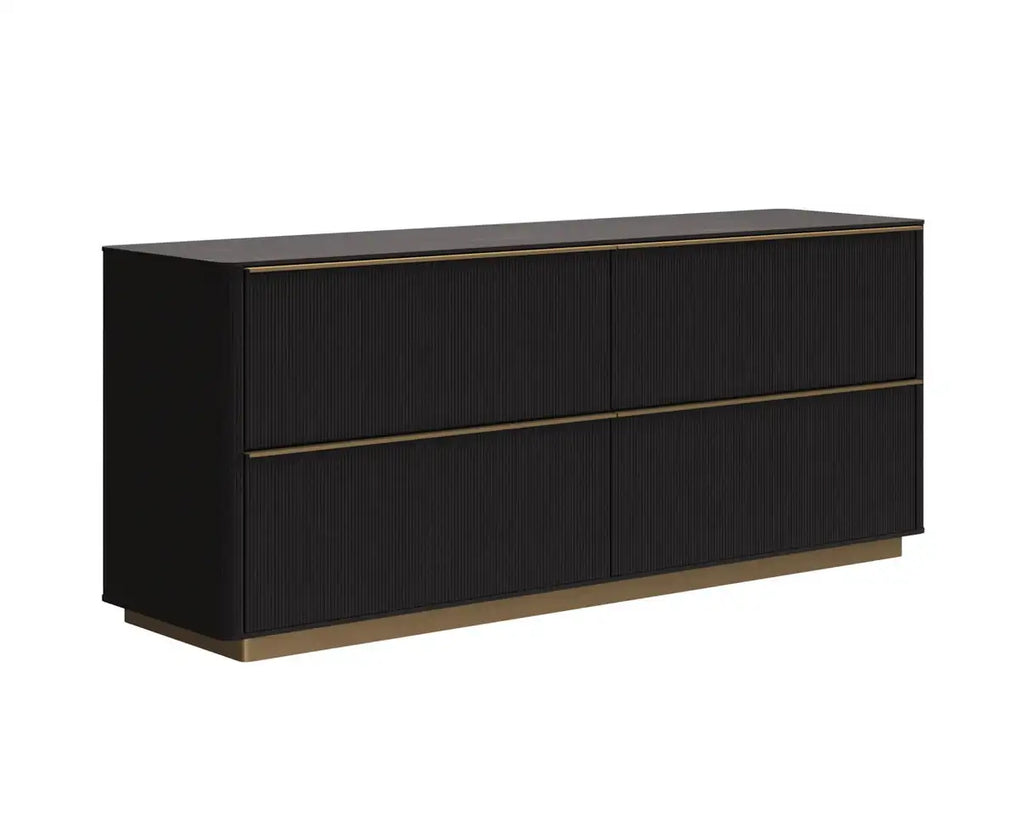
A wide or horizontal dresser is built along a low, broad profile. A double dresser, the most common format in this category, typically measures 36 to 50 inches tall and 58 to 72 inches wide, featuring two symmetrical columns of drawers for equitable side-by-side storage. Low dressers sit at the compact end of the horizontal range, generally under 36 inches tall, and are the format most associated with contemporary, Scandinavian, and minimalist bedroom design, where the lower visual profile keeps the room feeling open and unencumbered.

The Design Advantage of a Wide Dresser Surface

The wide dresser’s primary design advantage is its surface. The broad, low top creates a natural horizontal plane for a mirror above, a pair of lamps, or a framed art arrangement, allowing the dresser to become part of the room’s overall composition in a way a tall dresser’s higher surface cannot. A double dresser also anchors a bedroom wall differently, extending horizontally to ground the room and create a strong focal point when paired with a mirror or artwork positioned above it.

Choosing a Dresser for a Small Bedroom

In a small bedroom, the tall dresser resolves the storage question most efficiently. Its narrow footprint, typically 30 to 36 inches wide, allows placement in a corner, alongside a door, or between furniture pieces without consuming significant wall width. Montreal condo bedrooms in neighbourhoods like Griffintown and Mile-Ex often run on the compact side, where a tall dresser leaves adequate clearance for a bed, nightstands, and circulation while a wide dresser can eliminate furniture flexibility entirely.

Choosing a Dresser for a Master Bedroom

In a master bedroom or spacious suite, a wide or double dresser is the natural anchor piece. It fills a long wall proportionally, creates a generous surface for the room’s secondary composition, and provides the storage a shared bedroom requires in a single cohesive piece. In Outremont, Westmount, and older Montreal homes where master bedrooms tend to be more generous, a double dresser below an oversized mirror creates a classical bedroom composition that genuinely grounds the room.

One Dresser or Two for a Shared Bedroom

The tall dresser vs wide dresser decision changes again when two people share a bedroom and each wants dedicated storage. Rather than one larger double dresser, some couples choose two matching tall dressers positioned on opposite walls or flanking a window, giving each person a private, symmetrical storage zone. This approach to shared bedroom storage works particularly well in primary bedrooms with enough wall length to support two dressers without crowding the room's circulation or competing with the bed for visual weight.

Ceiling Height and Dresser Proportion

Ceiling height bears directly on the tall dresser format. A highboy or tall chest in a room with 9-foot or higher ceilings reads as appropriately scaled and architecturally intentional. In a room with standard 8-foot ceilings, the same piece can feel oppressive. A vertical format also creates a useful design effect in rooms with lower ceilings: the narrow, tall piece draws the eye upward and makes the ceiling feel slightly higher, adding perceived volume without requiring structural changes to the space.

How Many Drawers Do You Actually Need

The most useful question before choosing between formats is not how much storage you want, but how many drawers you use and what size they need to be. A single occupant with a moderate wardrobe typically needs five to six drawers for folded clothing, which a standard tall chest provides without the floor footprint of a wide piece. A couple sharing one dresser generally needs six to nine drawers, making the double dresser with two columns the natural format for that scenario.

Drawer Depth and Wardrobe Compatibility

Drawer depth matters as much as count. Deep drawers with an interior depth of 18 inches or more accommodate sweaters, jeans, and folded trousers without compression; shallow drawers of 12 to 15 inches suit underwear, socks, and accessories. A dresser with a mix of drawer depths handles a complete wardrobe more efficiently than one configured uniformly. Buyers who keep most clothing in a wardrobe and use the dresser for overflow may find three to four drawers in a low dresser entirely sufficient for their needs.

Matching Material and Finish to Your Bedroom

Once the format is decided, material and finish determine how the dresser integrates into or leads the room’s design language. A lacquered tall dresser in a light, clean finish suits contemporary and minimalist bedrooms; a wood-tone chest in walnut or oak suits warm, transitional, and traditional rooms. Hardware is the underappreciated connector: the pull or knob finish should relate to one other metal in the room, typically the bed frame, a lighting fixture, or the nightstand pulls, creating cohesion without matched uniformity.

Close-up detail of curved three-drawer dresser in grey oak veneer with white lacquer top and round pewter hardware on cabriole legs
Charcoal upholstered wingback bed with matching two-tone white and walnut nightstand and six-drawer dresser in white panelled bedroom
Champagne beige upholstered bed with arched camelback headboard and matching curved three-drawer nightstands and bench on herringbone wood floor
Cream fan-pleated upholstered bed with bronze post finials beside sunburst-drawer nightstands and matching dresser in white panelled bedroom

Pairing a Dresser with a Bedroom Mirror

Dressers with mirrors are most naturally paired with wide or double dresser formats. The low, broad surface creates the proportional base a mirror above requires, and the mirror width should fall between 60 and 80 percent of the dresser’s width to read as visually balanced. Tall dressers with a mirror work effectively when the mirror is hung to the side rather than directly above the piece, creating an asymmetrical composition suited to contemporary and curated interiors. Explore Mobilart’s bedroom mirrors collection to find formats scaled for both tall and wide dresser configurations.

 Tall octagonal gold-framed full-length floor mirror leaning against white wall in minimalist studio with industrial metal stool and potted plant

How Mobilart Approaches This Decision

The tall versus wide decision is resolvable on paper, but the final choice only becomes clear at scale in a furnished context. At Mobilart’s showroom at 8260 Devonshire in Mont-Royal, tall dressers and double dressers are displayed in room-scaled bedroom settings where buyers evaluate proportion, finish quality, and drawer function alongside actual bed frames and nightstands. The design consultation integrates format, finish, hardware, and mirror relationship as a composed room decision. Complimentary white-glove delivery is available within a 60 KM radius across Canada; a fee applies beyond that distance.

FAQs

The defining distinction is orientation and proportion. A dresser is typically wide and relatively low, 30 to 50 inches tall and 50 to 70 inches wide, with multiple columns of drawers and a broad surface suited for a mirror above. A chest of drawers is taller and narrower, 50 to 65 inches tall and 30 to 40 inches wide, with a single column of drawers. In practice the terms are used interchangeably; what matters is the proportion logic each format brings to the room and how it interacts with available wall space and ceiling height.

Yes. A tall dresser is the most space-efficient storage format for a small bedroom because it maximizes vertical storage without consuming significant floor or wall area. A narrow chest at 30 to 36 inches wide can be placed in a corner, alongside a door, or between furniture pieces without disrupting circulation. One constraint applies in rooms with low ceilings: a tall dresser approaching ceiling height can make the room feel compressed, so in rooms under 9 feet, a mid-height chest at 50 to 55 inches reads better than a full-height piece at 60 to 65 inches.

A standard double dresser ranges from 58 to 72 inches in width, accommodating two side-by-side columns of drawers while fitting on most bedroom walls without overwhelming the space. Before purchasing, verify that the chosen width leaves at least 36 inches of clearance between the dresser front and any opposing furniture to allow all drawers to open fully. When the double dresser anchors the primary wall, it should occupy 60 to 75 percent of that wall’s width: proportionally grounded and intentional, with enough visual breathing room on either side to avoid a compressed appearance.

tall dresser works best when hung to the side of or offset from the piece rather than centred directly above it, creating an asymmetrical composition that suits the tall format’s narrow profile. If hanging a mirror directly above, keep the mirror width at approximately 50 to 70 percent of the dresser’s width and position it close to the top surface. The standard 6 to 8-inch gap that works above a wide dresser can read as disconnected when the dresser is already tall.

A dresser can sit near a window, but prolonged direct sunlight fades wood finishes and lacquer unevenly over time, so a spot with filtered or indirect light is preferable to full sun for most hours of the day. If a window placement is unavoidable, sheer curtains or blinds that soften exposure during peak sunlight hours help protect the finish. Positioning two matching dressers to flank a window, rather than placing one directly in the light path, is often the more balanced solution.

A common guideline is to leave at least 36 inches of distance between a dresser and the bed's foot, which allows comfortable walking space and enough clearance for drawers to open without bumping into the bed frame. In smaller bedrooms where 36 inches is not available, positioning the dresser along a side wall rather than directly opposite the bed's foot often solves the clearance problem without sacrificing storage. Measuring each drawer's pull-out depth in advance confirms the space is truly sufficient.

Drawer Title

This website uses cookies to ensure you get the best experience on our website.

Similar Products