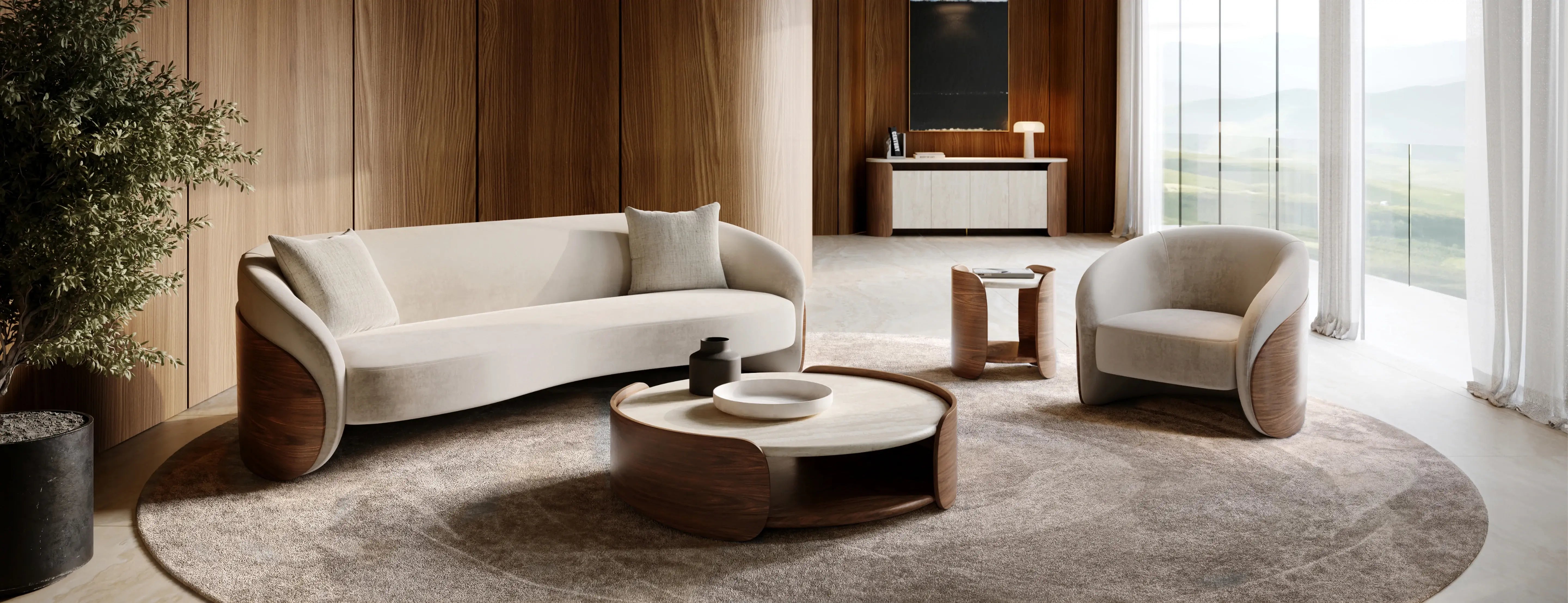
Tables basses en bois clair et foncé : choisir votre ton
La première décision est le ton, car il détermine la perception d'une table basse en bois dans la pièce :
Table basse en bois clair
Les finitions en chêne naturel et en frêne apportent de la luminosité et de l'ouverture à un salon, faisant d'une table basse en bois clair un choix naturel pour les intérieurs scandinaves, japandi et contemporains. Verni pour préserver le grain sans assombrir le ton, le bois clair s'harmonise facilement avec les tissus d'ameublement blancs, crème et neutres et convient particulièrement bien aux pièces où l'expansion visuelle est une priorité.
Table basse en bois foncé
Les finitions en noyer et teinté espresso ancrent la pièce avec richesse et profondeur. Une table basse en bois foncé convient aux intérieurs traditionnels et modernes du milieu du siècle, s'associant naturellement aux tons de tissus d'ameublement profonds – marine, vert forêt, anthracite – et aux accents métalliques chauds. Le bois dur foncé développe une patine plus profonde au fil des années d'utilisation, ce qui est l'une des caractéristiques qui en font un choix d'investissement de qualité.
Essences de bois — Noyer, Chêne, et au-delà
Le choix de l'essence est une décision de design autant qu'une décision matérielle.
Tables basses en noyer
Le noyer va du brun chocolat à l'ambre foncé, avec un grain fluide en forme de ruban qui est parmi les plus recherchés dans les meubles de luxe. Une table basse en noyer offre une densité mi-dure — résistante aux rayures quotidiennes tout en conservant un ton chaleureux — et s'associe naturellement avec le cuir, la bouclette et le velours dans les pièces transitionnelles et contemporaines.
Tables basses en chêne
Le chêne offre un grain plus serré et plus prononcé avec des tons dorés à brun clair, ce qui en fait l'essence de bois dur la plus polyvalente de la collection. Une table basse en chêne résiste mieux aux chocs et à l'humidité que la plupart des bois domestiques, et son caractère neutre s'intègre à travers les styles scandinaves, rustiques et transitionnels sans exiger de palette spécifique.
Tables basses en bois recyclé et à bord naturel
Les tables basses en bois recyclé sont fabriquées à partir de bois récupéré dans des granges, des usines et des arbres urbains abattus — un matériau avec une histoire que le bois fraîchement coupé ne peut pas reproduire. Le grain, le motif des nœuds et la variation de couleur de chaque pièce récupérée sont entièrement uniques, faisant de chaque table un objet véritablement unique plutôt qu'une variante de production.
Les designs à bord naturel vont plus loin en préservant le profil extérieur naturel de la dalle – la limite organique non coupée de l'arbre original. Le résultat est sculptural, indéniablement artisanal, et impossible à reproduire à grande échelle. Les formats recyclés et à bord naturel présentent tous deux un avantage de durabilité inhérent : le bois recyclé détourne des matériaux utilisables des décharges tout en préservant les ressources forestières anciennes. La sélection raffinée de Mobilart intègre cette catégorie artisanale dans un contexte de vente au détail de luxe où la qualité et la provenance sont les critères de sélection.
Comment entretenir une table basse en bois : protéger votre investissement
Le bois dur massif est l'un des matériaux de mobilier les plus tolérants lorsque l'entretien est constant et simple.
Dépoussiérez régulièrement avec un chiffon doux en microfibre pour enlever les particules de surface sans rayer la finition. Utilisez des sous-verres sous les verres et la céramique comme habitude standard — les cernes d'eau sont le problème de surface le plus courant sur les finitions en noyer et huilées brutes, et ils sont presque entièrement évitables. Appliquez un conditionneur de bois ou une cire pour meubles tous les trois à six mois pour maintenir l'intégrité de la surface et développer un éclat naturel au fil du temps. Traitez les éclaboussures immédiatement — l'eau stagnante est la principale cause de dommages à la finition sur les surfaces en bois dur.
Le principal avantage d'entretien que le bois massif offre par rapport aux alternatives composites est qu'il peut être légèrement poncé et reverni lorsque les surfaces montrent des signes d'usure, ce qui permet de remettre la surface de la table à neuf sans remplacer la pièce. Avec un entretien approprié, une table basse en bois dur massif est un investissement véritablement multigénérationnel.L'équipe de Mobilartpeut vous conseiller sur les produits d'entretien et de conditionnement au moment de l'achat.